Trust Funds, 2022 Edition
ORIGINAL EXAM, Instructor’s Version:
-

James Adams is a California broker (the same broker featured in the textbook). His brokerage sells residential real estate and manages five apartment buildings each owned by different clients. He charges his property management clients a management fee the last day of every month. His trust fund is held at the Bank of Burbank — a California, FDIC-insured bank.
Which is a trust fund?
(A) A commission for selling a home.
(B) An option to purchase.
(C) A gold bar offered as earnest money. → §2.1: Trust Funds and Non-Trust Funds , Page 3
- If James were to file for bankruptcy, while in bankruptcy his trust fund would be …
(A) frozen.
(B) unaffected. → §2.2: Why a Trust Account , Page 3
(C) distributed among his creditors.
- James collects rents on behalf of the owners of the apartments he manages. Upon receipt of any rent payment, James must deposit it into his trust account within …
(A) one month.
(B) one year.
(C) three business days. → §2.3: Trust Fund Handling Requirements , Page 4
- All trust funds must be placed into the trust account except a …
(A) deposit check pending acceptance of an offer. → §2.3: Trust Fund Handling Requirements , Page 4
(B) security deposit for an apartment lease.
(C) deposit check pending close of escrow.
- A broker may return his buyer’s earnest money deposit without the seller’s permission at any time before …
(A) he deposits the check into his trust account.
(B) his buyer completes escrow.
(C) the seller accepts his buyer’s offer. → §2.4: Identifying Owners of Trust Funds , Page 5
- Which of the following accounts could legally be a trust account?
(A) A savings account in the Cayman Islands.
(B) A revolving credit account with American Express.
(C) A checking account in Los Angeles, CA. → §3.1: General Requirements , Page 7
- James’ unlicensed office manager may withdraw funds from James’ trust account providing his office manager …
(A) has James’ full trust and confidence.
(B) is sufficiently bonded. → §3.2: Trust Account Withdrawals , Page 7
(C) is also his wife or domestic partner.
- A trust account with a single beneficiary may earn interest providing the earned interest inures to the benefit of the …
(A) The DRE.
(B) broker.
(C) beneficiary. → §3.3: Interest Bearing Accounts , Page 8
- If James’ property management fees are due and collectible from his trust account at the end of each month, he could be charged with commingling if he failed to withdraw his fees from his trust account within …
(A) 25 days. → §3.4: Commingling Prohibited , Page 9
(B) 2.5 days.
(C) 250 days.
- If the fund’s balance is less than its total liability, a trust fund …
(A) overage results.
(B) shortage results. → §3.5: Trust Fund Liability , Page 12
(C) profit results.
 This form is used to record …
(A) all transactions for a single beneficiary.
(B) all trust funds received or paid-out from the trust fund. → §4.3: Bank Account Record [#4522] , Page 16
(C) fees received in trust but not deposited into the trust fund.
- Jessica is a client of James’ property management service. She writes a check to Armando’s Painting Service and gives it to James for him to give to Armando when he next sees him. James must record this transaction if the check’s amount is over …
(A) $100,000.
(B) $10,000.
(C) $1,000. → §4.5: Record of Undeposited Receipts [#4524] , Page 18
- To James’ surprise, after reconciling his trust fund he discovers it holds $500 more than the fund owes its beneficiaries. This is known as an “unexplained trust fund
(A) overage.” → §7.4: Overages , Page 24
(B) bonus.”
(C) profit.”
- Brokers must retain canceled checks for any real estate transaction for at least …
(A) three days.
(B) three years. → §10.0: Audits and Examinations , Page 31
(C) thirty years.
- If the Commissioner finds that a broker has converted trust funds he may …
(A) suspend his license and petition the Superior Court for injunctive relief. → §11.0: Consequences of Conversion , Page 33
(B) confiscate the trust funds for DRE’s Recovery Account.
(C) seize the broker’s personal assets.
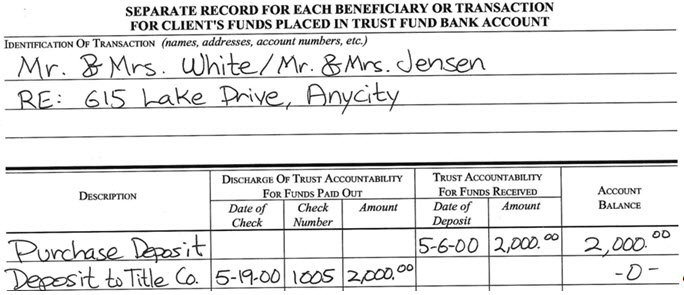 A plausible explanation for the entries shown below could be: “On May 6th, James deposited the White’s $2,000 earnest money deposit into his trust fund and on the 19th he wrote a check for that same amount to their escrow.”
(A) TRUE → §12.0: Sample Transactions , Page 35
(B) FALSE
Trust Funds, 2022 Edition
RETAKE EXAM, Instructor’s Version:
-
James Adams is a California broker (the same broker featured in the textbook). His brokerage sells residential real estate and manages five apartment buildings each owned by different clients. He charges his property management clients a management fee the last day of every month. His trust fund is held at the Bank of Burbank — a California, FDIC-insured bank.
Which is not a trust fund?
(A) A purchase deposit held by a broker.
(B) Rents held by a property manager.
(C) A management fee owed to a broker. → §2.1: Trust Funds and Non-Trust Funds , Page 3
-
James has two trust accounts at the same bank. The first has two beneficiaries; the second, only one. Should the bank fail, FDIC’s maximum payout to James’ three beneficiaries would be …
(A) $250K times two.
(B) $250K times three. → §2.2: Why a Trust Account , Page 3-4
(C) $250K times one.
-
Trust funds should be placed into a …
(A) neutered escrow guardianship.
(B) neural escrow network.
(C) neutral escrow depository. → §2.3: Trust Fund Handling Requirements , Page 4
-
The seller’s broker may hold the buyer’s deposit check uncashed after his seller accepts the buyer’s offer providing he has written approval from …
(A) his seller. → §2.3: Trust Fund Handling Requirements , Page 4
(B) the buyer.
(C) both the buyer and his seller.
-
Once the seller has accepted an offer, his broker may not return the buyer’s purchase money deposit without first obtaining written permission from …
(A) the buyer and his seller.
(B) the buyer.
(C) his seller. → §2.4: Identifying Owners of Trust Funds , Page 5
-
A trust fund must be in the name of the broker as …
(A) “beneficiary.”
(B) “trustor.”
(C) “trustee.” → §3.1: General Requirements , Page 7
-
Withdrawals from a trust fund may not be made by a …
(A) corporate licensee’s designated officer.
(B) beneficiary. → §3.2: Trust Account Withdrawals , Page 7
(C) salesperson licensed to and authorized by the broker.
-
Trust fund accounts are normally …
(A) interest bearing savings accounts.
(B) speculative hedge fund accounts.
(C) non-interest bearing checking accounts. → §3.3: Interest Bearing Accounts , Page 8
-
James would be in violation of “commingling” if he …
(A) paid his office lease from a check drawn from his trust fund. → §3.4: Commingling Prohibited , Page 10
(B) deposited $120 of his own money into his trust to cover the bank’s service fees.
(C) promptly withdrew his management fees from his fund.
-
A DRE auditor who finds more money in a broker’s trust fund than the broker owes his beneficiaries may charge the broker with …
(A) conversion.
(B) commingling. → §3.5: Trust Fund Liability , Page 12
(C) fraud.
-
This form is used to …
(A) detail funds received from and sent to an individual beneficiary.
(B) journalize all funds into and out of the fund. → §4.3: Bank Account Record [#4522] , Page 16
(C) list funds received but not deposited into the fund.
-
James receives three checks from Sally – the owner of an apartment James manages. Which of her three checks must James record in his trust accounting system? A check for …
(A) $900; payable to Martha’s Appraisal Service.
(B) $90; payable to Claudio’s Plumbing Supplies.
(C) $9; payable to himself (James). → §4.5: Record of Undeposited Receipts [#4524] , Page 18
-
An “unexplained trust account overage” …
(A) remains in the trust fund. → §7.4: Overages , Page 24
(B) should be retained by the broker.
(C) may be used to offset future shortages.
-
Which of the following is not required to document a real estate transaction?
(A) Deposit receipts
(B) Photographs of the transferred property → §10.0: Audits and Examinations , Page 31
(C) Cancelled checks
-
If the Commissioner finds that a broker has converted trust funds, he may petition the Superior Court for injunctive relief including a claim for …
(A) restitution for the fund‘s beneficiaries. → §11.0: Consequences of Conversion , Page 33
(B) fines payable to DRE’s Recovery Fund.
(C) fines payable to the Board of Equalization.
-
 A plausible explanation for the last entry shown here is: “James received a purchase deposit of $3K from Mr. Olive on May 22nd, held it uncashed, and returned it two days later.”
(A) TRUE → §12.0: Sample Transactions , Page 36
(B) FALSE
Trust Funds, 2022 Edition
ORIGINAL EXAM, Participant’s Version:
-
James Adams is a California broker (the same broker featured in the textbook). His brokerage sells residential real estate and manages five apartment buildings each owned by different clients. He charges his property management clients a management fee the last day of every month. His trust fund is held at the Bank of Burbank — a California, FDIC-insured bank.
Which is a trust fund?
(A) A commission for selling a home.
(B) An option to purchase.
(C) A gold bar offered as earnest money.
- If James were to file for bankruptcy, while in bankruptcy his trust fund would be …
(A) frozen.
(B) unaffected.
(C) distributed among his creditors.
- James collects rents on behalf of the owners of the apartments he manages. Upon receipt of any rent payment, James must deposit it into his trust account within …
(A) one month.
(B) one year.
(C) three business days.
- All trust funds must be placed into the trust account except a …
(A) deposit check pending acceptance of an offer.
(B) security deposit for an apartment lease.
(C) deposit check pending close of escrow.
- A broker may return his buyer’s earnest money deposit without the seller’s permission at any time before …
(A) he deposits the check into his trust account.
(B) his buyer completes escrow.
(C) the seller accepts his buyer’s offer.
- Which of the following accounts could legally be a trust account?
(A) A savings account in the Cayman Islands.
(B) A revolving credit account with American Express.
(C) A checking account in Los Angeles, CA.
- James’ unlicensed office manager may withdraw funds from James’ trust account providing his office manager …
(A) has James’ full trust and confidence.
(B) is sufficiently bonded.
(C) is also his wife or domestic partner.
- A trust account with a single beneficiary may earn interest providing the earned interest inures to the benefit of the …
(A) The DRE.
(B) broker.
(C) beneficiary.
- If James’ property management fees are due and collectible from his trust account at the end of each month, he could be charged with commingling if he failed to withdraw his fees from his trust account within …
(A) 25 days.
(B) 2.5 days.
(C) 250 days.
- If the fund’s balance is less than its total liability, a trust fund …
(A) overage results.
(B) shortage results.
(C) profit results.
-
This form is used to record …
(A) all transactions for a single beneficiary.
(B) all trust funds received or paid-out from the trust fund.
(C) fees received in trust but not deposited into the trust fund.
- Jessica is a client of James’ property management service. She writes a check to Armando’s Painting Service and gives it to James for him to give to Armando when he next sees him. James must record this transaction if the check’s amount is over …
(A) $100,000.
(B) $10,000.
(C) $1,000.
- To James’ surprise, after reconciling his trust fund he discovers it holds $500 more than the fund owes its beneficiaries. This is known as an “unexplained trust fund
(A) overage.”
(B) bonus.”
(C) profit.”
- Brokers must retain canceled checks for any real estate transaction for at least …
(A) three days.
(B) three years.
(C) thirty years.
- If the Commissioner finds that a broker has converted trust funds he may …
(A) suspend his license and petition the Superior Court for injunctive relief.
(B) confiscate the trust funds for DRE’s Recovery Account.
(C) seize the broker’s personal assets.
-
A plausible explanation for the entries shown below could be: “On May 6th, James deposited the White’s $2,000 earnest money deposit into his trust fund and on the 19th he wrote a check for that same amount to their escrow.”
(A) TRUE
(B) FALSE
Trust Funds, 2022 Edition
RETAKE EXAM, Participant’s Version:
-
James Adams is a California broker (the same broker featured in the textbook). His brokerage sells residential real estate and manages five apartment buildings each owned by different clients. He charges his property management clients a management fee the last day of every month. His trust fund is held at the Bank of Burbank — a California, FDIC-insured bank.
Which is not a trust fund?
(A) A purchase deposit held by a broker.
(B) Rents held by a property manager.
(C) A management fee owed to a broker.
-
James has two trust accounts at the same bank. The first has two beneficiaries; the second, only one. Should the bank fail, FDIC’s maximum payout to James’ three beneficiaries would be …
(A) $250K times two.
(B) $250K times three.
(C) $250K times one.
-
Trust funds should be placed into a …
(A) neutered escrow guardianship.
(B) neural escrow network.
(C) neutral escrow depository.
-
The seller’s broker may hold the buyer’s deposit check uncashed after his seller accepts the buyer’s offer providing he has written approval from …
(A) his seller.
(B) the buyer.
(C) both the buyer and his seller.
-
Once the seller has accepted an offer, his broker may not return the buyer’s purchase money deposit without first obtaining written permission from …
(A) the buyer and his seller.
(B) the buyer.
(C) his seller.
-
A trust fund must be in the name of the broker as …
(A) “beneficiary.”
(B) “trustor.”
(C) “trustee.”
-
Withdrawals from a trust fund may not be made by a …
(A) corporate licensee’s designated officer.
(B) beneficiary.
(C) salesperson licensed to and authorized by the broker.
-
Trust fund accounts are normally …
(A) interest bearing savings accounts.
(B) speculative hedge fund accounts.
(C) non-interest bearing checking accounts.
-
James would be in violation of “commingling” if he …
(A) paid his office lease from a check drawn from his trust fund.
(B) deposited $120 of his own money into his trust to cover the bank’s service fees.
(C) promptly withdrew his management fees from his fund.
-
A DRE auditor who finds more money in a broker’s trust fund than the broker owes his beneficiaries may charge the broker with …
(A) conversion.
(B) commingling.
(C) fraud.
-
This form is used to …
(A) detail funds received from and sent to an individual beneficiary.
(B) journalize all funds into and out of the fund.
(C) list funds received but not deposited into the fund.
-
James receives three checks from Sally – the owner of an apartment James manages. Which of her three checks must James record in his trust accounting system? A check for …
(A) $900; payable to Martha’s Appraisal Service.
(B) $90; payable to Claudio’s Plumbing Supplies.
(C) $9; payable to himself (James).
-
An “unexplained trust account overage” …
(A) remains in the trust fund.
(B) should be retained by the broker.
(C) may be used to offset future shortages.
-
Which of the following is not required to document a real estate transaction?
(A) Deposit receipts
(B) Photographs of the transferred property
(C) Cancelled checks
-
If the Commissioner finds that a broker has converted trust funds, he may petition the Superior Court for injunctive relief including a claim for …
(A) restitution for the fund‘s beneficiaries.
(B) fines payable to DRE’s Recovery Fund.
(C) fines payable to the Board of Equalization.
-
A plausible explanation for the last entry shown here is: “James received a purchase deposit of $3K from Mr. Olive on May 22nd, held it uncashed, and returned it two days later.”
(A) TRUE
(B) FALSE